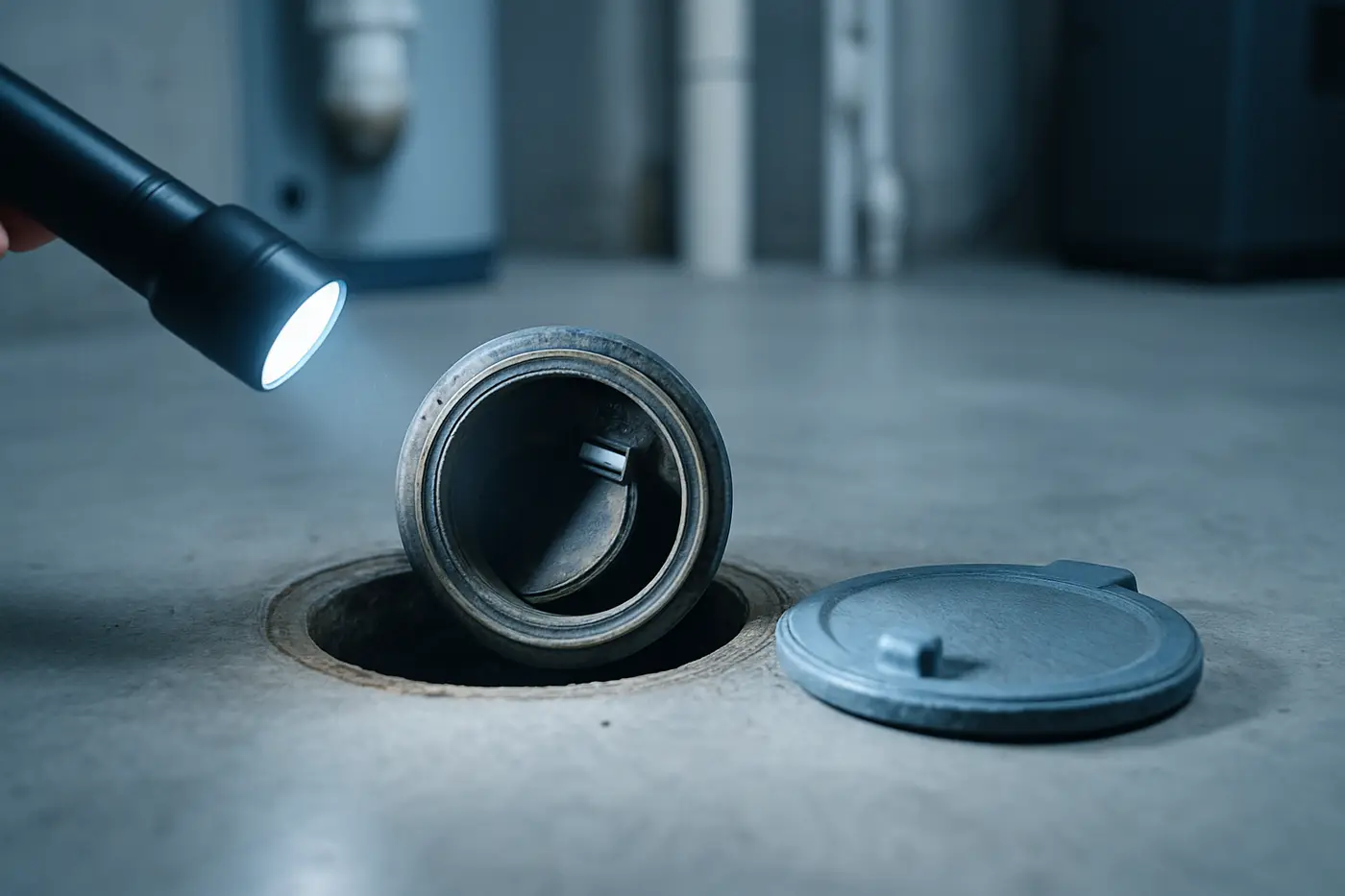
If your basement has a floor drain, toilet, shower or laundry, it needs protection from sewer backup. How full-port and branch valves differ, what the permit involves and what a retrofit costs.
If your Calgary home has a floor drain, toilet, shower, laundry or any other fixture below grade, it needs protection from sewer backup from the street. The City of Calgary’s guide says Alberta’s plumbing code requires it, and the City recommends a backwater valve for below-grade fixtures. In an existing home, a retrofit typically costs $1,800–$4,500 before GST, needs a plumbing permit, and a full-port valve then needs servicing every year at a typical $150–$350. There is no City of Calgary backwater valve rebate we can point you to, so budget for the full cost. The rest of this guide explains which type of valve fits your house, what the install involves, and how it works with a sump pump.
What a backwater valve does
A backwater valve is a one-way valve on your sewer line. Under normal conditions, wastewater flows out of the house through it toward the City main. If the flow reverses, because the main is surcharged or blocked, a flap closes and keeps sewage from pushing back up into your basement through the floor drain, toilet or shower.
The important thing to understand is that while the flap is closed, nothing from the house can get out either. If people keep flushing and running laundry upstairs during a backup, that water has nowhere to go and can come up the lowest drain on your side of the valve. When you know the City sewer is backing up in your area, use as little water as possible until it clears.
A backwater valve also does nothing for a blockage in your own line between the house and the valve. Tree roots or grease in the private pipe still cause backups. For that situation, see our guide to sewage coming up the floor drain.
Who needs one in Calgary
The City’s guide is direct: “Alberta’s plumbing code requires that any fixture below grade must be protected from sewer back up from the street.” That includes floor drains and basement bathrooms. The National Plumbing Code of Canada 2020, in force in Alberta since April 1, 2023 and applied by Calgary to permits from October 1, 2023, requires below-street-level fixtures subject to backflow to be protected.
In practice:
- New houses: backwater valves are checked at the groundwork inspection, so a new home built under a permit should have backwater protection in place. If you live in a newer community such as Redstone, find out where your valve is and put its annual service on the calendar.
- Existing houses: the City recommends installing a backwater valve on below-grade fixtures. If you are not sure whether your house has one, look for an access cover in the basement floor near where the main drain leaves the house, often in the furnace room. If you cannot find one, a plumber can confirm it with a camera.
- Basement renovations: adding a basement bathroom or laundry is a plumbing alteration that needs a permit, and the new fixtures need backwater protection.
We cannot tell you a year after which every Calgary home was built with one, so do not assume based on age alone. Check.
Full-port or branch valves
The City’s guide describes two ways to protect below-grade fixtures: one full-port valve on the main sewer, or individual valves on the branches that serve basement fixtures.
| Full-port backwater valve | Branch backwater valves | |
|---|---|---|
| Where it goes | On the main building sewer, protecting the whole house | On individual branch lines serving below-grade fixtures |
| What it protects | Every fixture upstream of the valve | Only the fixtures on that branch |
| Maintenance (City guide) | Servicing every year | No annual servicing required |
| Watch-outs | Upstairs drains are blocked too while the flap is closed | Each below-grade fixture must be covered by a valve |
| Secondary suites | A normally open valve may not serve more than one dwelling unit | Layout depends on how each unit drains |
Which one fits depends on how your basement plumbing is laid out, where the building sewer runs and whether there is a suite. A plumber will look at the drain layout, often with a camera, before recommending one.
Secondary suites count as a separate unit
This catches people out. According to a City advisory dated October 4, 2022, a normally open backwater valve may not serve more than one dwelling unit, and a secondary suite counts as a separate dwelling unit. If your house has, or will have, a basement suite, the backwater protection has to be designed with that in mind. Sort it out at the permit stage rather than after the floor has been patched.
The install: permit, slope and concrete
Installing a backwater valve needs a plumbing permit. To pull trade permits in Calgary, a business needs a City Contractor business licence and registration as a City Qualified Tradesperson. Owner-occupants doing their own work can apply for a homeowner permit ($116.50 including the Safety Codes fee), but that option is not available for rentals or apartment condos, and cutting into a main sewer is not a beginner job.
A typical retrofit looks like this:
- Camera the line to confirm where the building sewer runs and its condition.
- Cut and remove a section of the basement floor over the sewer.
- Excavate down to the pipe and cut in the valve. The pipe must slope at least 2% toward the municipal sewer.
- Install an access so the valve can be serviced.
- Inspection under the permit, then backfill and patch the concrete.
| Item | Typical Calgary range (before GST) | Notes |
|---|---|---|
| Backwater valve installation (retrofit) | $1,800–$4,500 | Floor cut, permit, concrete patch |
| Backwater valve service / cleaning | $150–$350 | Annual for full-port valves |
| Sewer camera inspection | $250–$550 | Often credited toward repair |
| Main sewer line clearing (through cleanout) | $250–$650 | If the line needs clearing first |
| Sump pump replacement | $600–$1,800 | Pump, check valve, discharge |
These are typical ranges; the final price is quoted on site in writing before work starts, GST extra. Our backwater valve service page covers the retrofit in more detail, and our sewer line repair page covers what happens if the camera finds a broken pipe.
Annual servicing: why it matters
A full-port valve sits in the sewer, so it collects grease, paper and debris. The City says full-port valves need servicing every year. A service visit usually means opening the access cover, cleaning the flap and seat, confirming the flap swings freely and closes fully, and checking that the cover seals.
A valve that is ignored can fail two ways. Stuck open, it gives no protection when you need it. Stuck closed or partly closed, it slows your own drains and can back them up. Fall is a sensible time to book it, alongside the other jobs on our fall plumbing checklist.
How it works with a sump pump
A backwater valve and a sump pump deal with different water. The valve protects against sewage from the sanitary sewer. The sump pump handles groundwater collected by the weeping tile around your foundation.
City rules and advice for sumps:
- Foundation drainage must not go into the sanitary sewer without a permit, except foundation drainage connected before 1973.
- Discharge must not flow onto neighbours, lanes, sidewalks, boulevards or streets, or back into the weeping tile. The City says to discharge two metres from the foundation.
- Use a backup pump with battery or generator power, a check valve on the discharge and a high-water alarm, and replace the pump every 10 years or sooner.
- Sump maintenance is the homeowner’s job, and the City does not respond to these calls.
Older homes near the rivers, including Elbow Park and much of SW Calgary along the Elbow, often have both finished basements and older sewer laterals, which makes checking both systems worthwhile.
Insurance
Sewer backup is typically not covered by a standard Canadian home policy; most insurers offer it as optional coverage, and the City lists sewer backup, overland water and groundwater as optional add-ons. Ask your insurer whether a backwater valve affects your sewer backup coverage, and keep the permit and service records in your house file either way.
FAQ
Common Questions
Is a backwater valve required in Calgary?
The City of Calgary's guide says Alberta's plumbing code requires that any fixture below grade must be protected from sewer backup from the street, including floor drains and basement bathrooms. The National Plumbing Code of Canada 2020, in force in Alberta, requires below-street-level fixtures subject to backflow to be protected. On new houses, backwater valves are checked at the groundwork inspection. For an existing home, the City recommends installing a backwater valve on below-grade fixtures, and installing one needs a plumbing permit.
How much does it cost to install a backwater valve in Calgary?
A retrofit backwater valve installation typically runs $1,800–$4,500 in Calgary before GST. The range covers cutting and removing the basement floor, excavating to the sewer line, installing the valve with the correct slope, the plumbing permit and patching the concrete. Where the price lands depends on how deep the line is, what is in the way, such as finished flooring or walls, and whether a camera inspection is needed first. The final price is quoted on site in writing before work starts.
Is there a City of Calgary rebate for backwater valves?
There is no City of Calgary backwater valve rebate that we can point you to, so plan to pay the full cost of a retrofit yourself. The only City rebate we are aware of in the plumbing area is for homes identified as having a lead service line, which covers certain drinking water filters or treatment units. If you see a backwater valve rebate advertised, confirm it directly with the City through 311 before you rely on it.
How often does a backwater valve need servicing?
The City's guide says full-port backwater valves need servicing every year; branch valves do not. Servicing means opening the access cover, cleaning the flap and seat, checking that the flap moves freely and closes fully, and making sure the cover seals. A typical backwater valve service or cleaning costs $150–$350 in Calgary before GST. A valve that is never cleaned can stick open, which gives no protection, or stick closed, which can back up your own drains.
Does a basement suite need its own backwater valve?
It can affect the layout. According to a City advisory from October 4, 2022, a normally open backwater valve may not serve more than one dwelling unit, and a secondary suite counts as a separate dwelling unit. That means a house with a secondary suite may need its backwater protection arranged differently from a single-family home. Your plumber works this out with the permit, based on how the suite and main floor drain into the building sewer.
Is a backwater valve the same as a sump pump?
No. A backwater valve sits on the sanitary sewer and stops sewage from the street flowing back into your basement. A sump pump deals with groundwater collected by the weeping tile around the foundation and pumps it outside. They protect against different kinds of water, so many basements benefit from both. The City's advice for sumps includes a backup pump with battery or generator power, a check valve on the discharge and a high-water alarm.
- #backwater valve
- #sewer backup
- #basement
- #plumbing permit
- #calgary