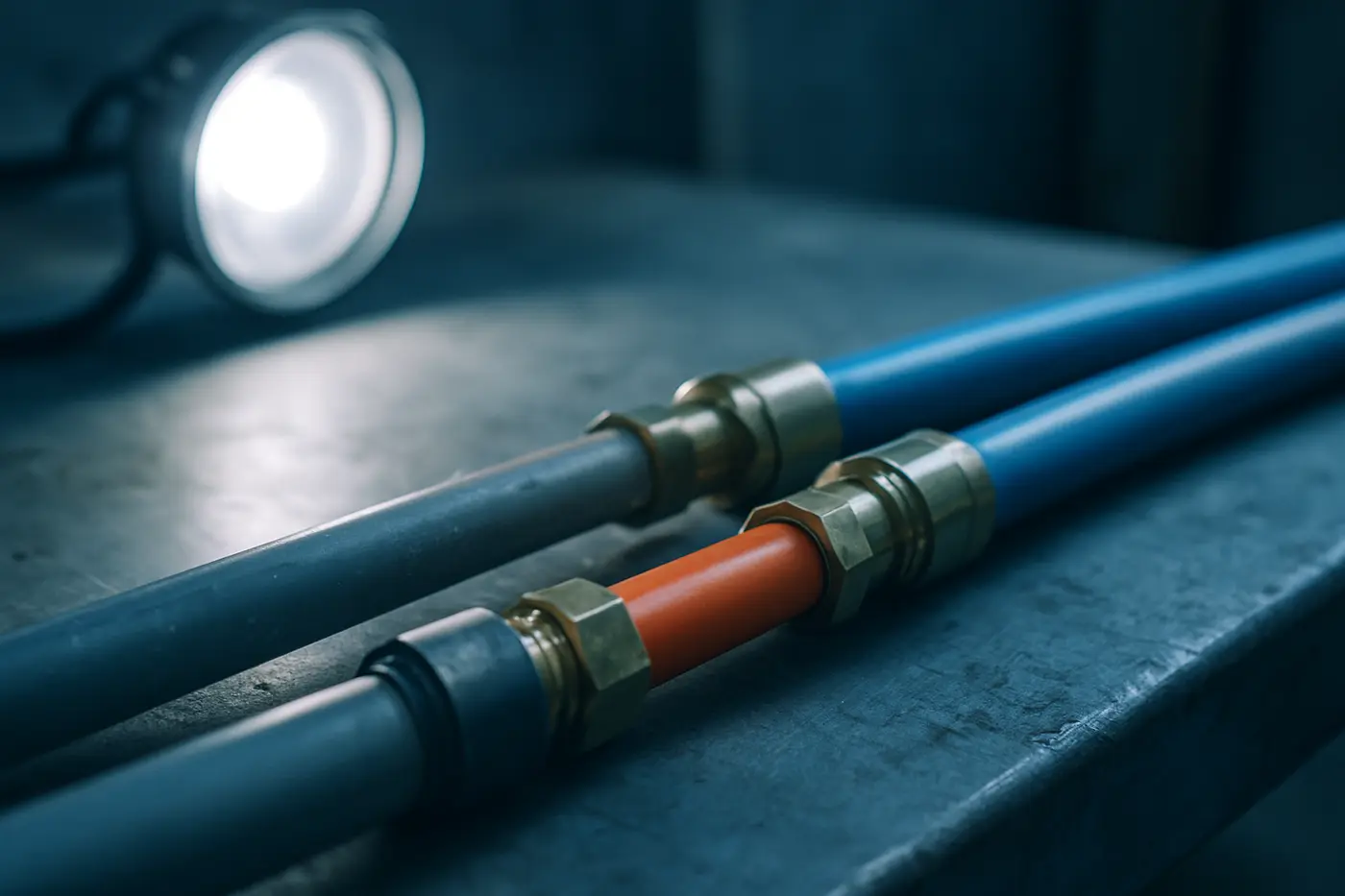
Grey plastic supply pipe usually means Poly-B; orange and blue pipe with brass fittings often means Kitec. How to identify each, what to do when one leaks, and when a planned repipe makes sense.
If the supply pipe you can see in your Calgary basement is grey plastic, it is most likely Poly-B, and if it is orange and blue pipe joined with brass fittings, it is often Kitec. Both are known to fail, mostly at the fittings, and neither has any settlement money left to claim. The practical plan is: confirm what you have, make sure everyone in the house knows where the main shut-off is, fix any leak properly when it happens, and budget for a planned whole-home repipe to PEX, which typically costs $6,500–$16,000 before GST, drywall repair not included. A planned repipe on a weekday costs less, overall, than a string of after-hours leak calls.
How to identify Poly-B
Poly-B is polybutylene, a grey plastic supply pipe. It was installed in millions of homes in the US and Canada from around 1978 to 1997. It is usually joined with crimp fittings, metal bands squeezed around the pipe over an insert, rather than soldered joints.
Where to look in a typical Calgary house:
- At the hot water tank, on the cold inlet and hot outlet.
- Near the main shut-off valve, which is usually in the basement where the water line comes in.
- In an unfinished furnace room or basement ceiling, where the supply lines branch off.
- Under kitchen and bathroom sinks, where the supply comes out of the wall to the shut-off valve.
Do not judge by one spot. Many houses were partly repiped over the years, so a section of copper at the tank does not mean the rest of the house is copper. If you see grey plastic anywhere on the supply side, have a plumber confirm what is behind the walls.
How to identify Kitec
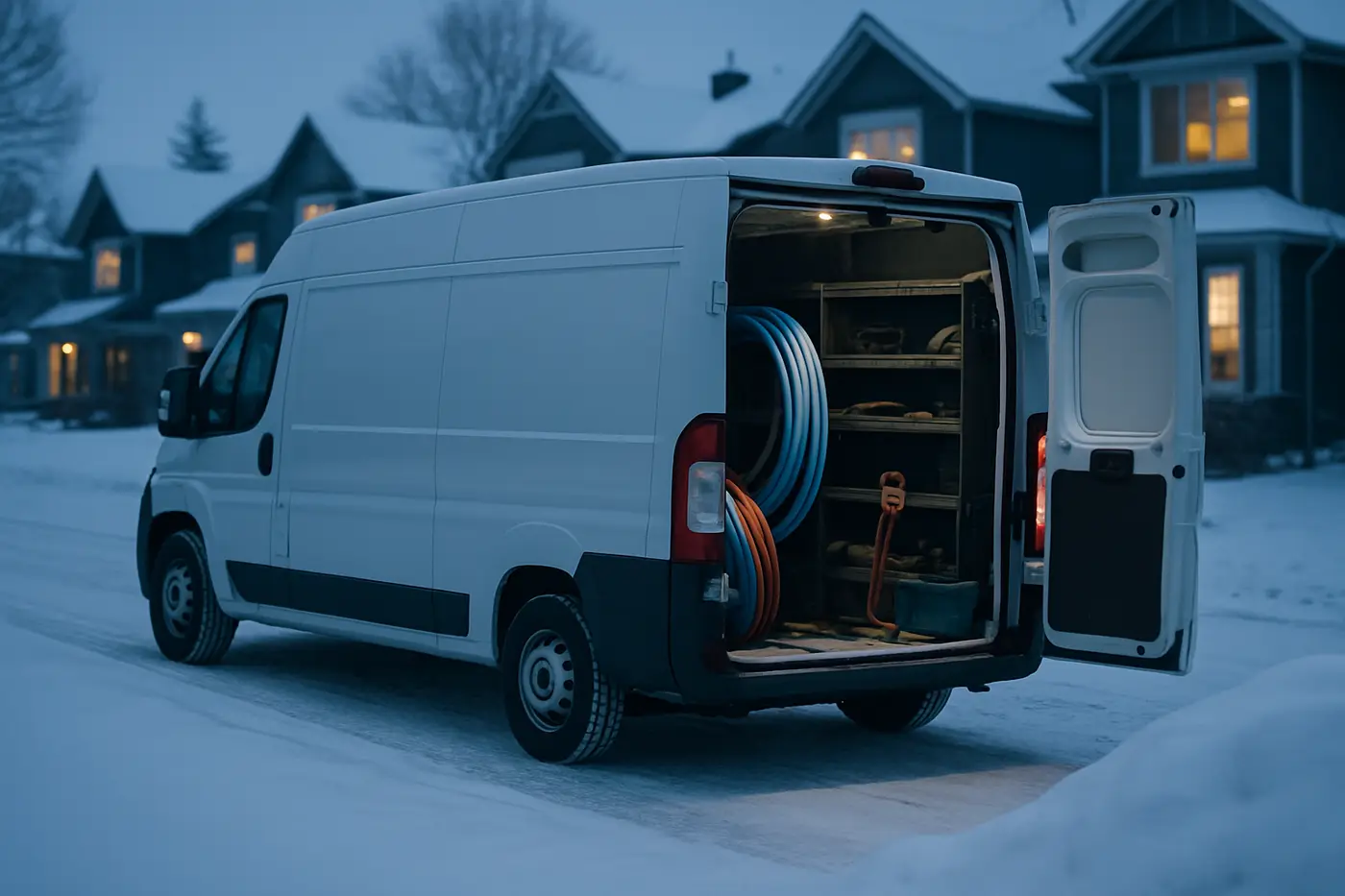
Kitec is a brand of PEX-AL-PEX pipe made by IPEX: a plastic pipe with a thin aluminium layer inside, joined with brass fittings. It was sold from 1995 to 2007, so it overlaps the end of the Poly-B era. It is often orange for hot water and blue for cold.
The brass fittings are the weak point and can fail. Look at the same places as for Poly-B: the hot water tank, the main shut-off area and any open ceiling in the basement.
| Poly-B | Kitec | |
|---|---|---|
| Material | Polybutylene plastic | PEX-AL-PEX (plastic with aluminium layer) |
| Typical colour | Grey | Often orange (hot) and blue (cold) |
| Fittings | Usually crimp fittings | Brass fittings |
| Era installed or sold | Around 1978 to 1997 | Sold 1995 to 2007 |
| Where it fails | At fittings and along runs | Brass fittings can fail |
| Settlement status | Canadian class actions settled (DuPont 2002–2003, Shell 2004), all closed | US$125 million settlement (2011), claims deadline January 9, 2020, closed |
Which Calgary homes are most likely to have it
Age is the first clue. Communities built during the Poly-B years are the obvious places to check. Falconridge, established in 1979, falls squarely in that era, and so do plenty of other communities across NE Calgary and the rest of the city that were built in the 1980s and 1990s. In Tuscany, established in 1994, Poly-B is possible in the earliest phases. Homes from the late 1990s to mid-2000s are the ones to check for Kitec.
Older homes are not automatically clear either. A house built long before 1978 may have had its original galvanized or copper supply replaced with Poly-B during a renovation in those years. The only reliable answer is to look at the pipe.
Why they fail
Poly-B fails at fittings and along runs. Failures often show up without much warning, as a weeping fitting or a split that lets go under normal pressure. Kitec’s known problem is its brass fittings, which can fail over time.
For a homeowner, the risk is not the pipe you can see in the furnace room. It is the fitting inside a finished wall or above a basement ceiling that lets go while you are at work. By the time the water shows up, the drywall, insulation and flooring below have taken it.
Living with it until the repipe
If a repipe is a year or two away, a few habits cut the risk:
- Test the main shut-off now. Turn it off and on again while nothing is wrong. A valve that has not moved in years can seize, and you want to find that out on a quiet afternoon, not during a leak.
- Look at the fittings you can see every few months, especially at the hot water tank and in the furnace room. Damp spots, drips, staining or corrosion around a fitting are reasons to call before it lets go.
- Shut the water off when you travel. An empty house with the main off cannot flood.
- Tell anyone house-sitting where the shut-off is.
When it leaks: the emergency steps
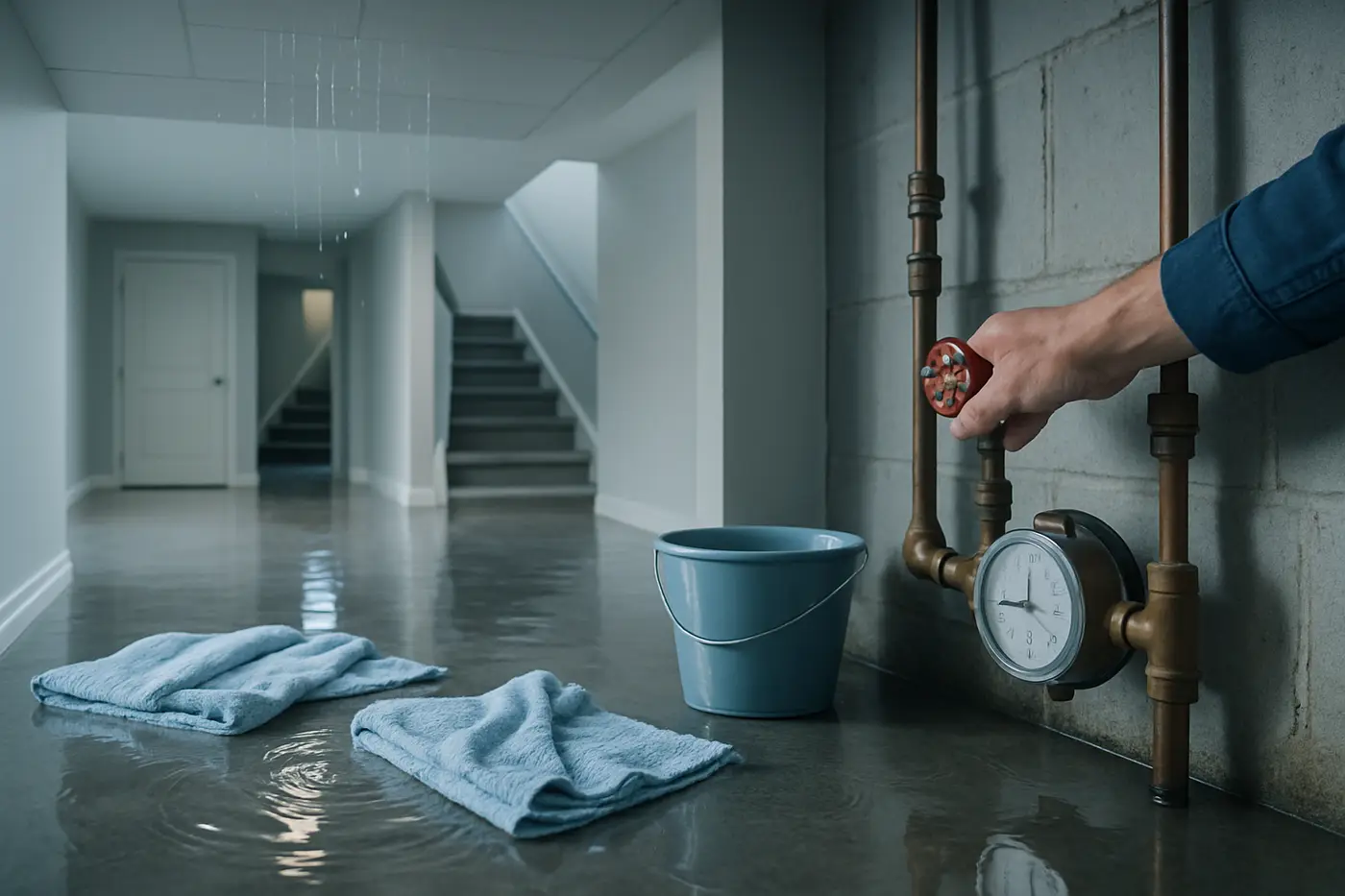
- Shut off the main water valve. You own the main shut-off inside the house, and in most Calgary homes it is in the basement near the water meter. Know where it is before you need it, and make sure it turns.
- Turn off power to anything wet if you can do it safely, and stay out of water near outlets or the panel.
- Open a tap on the lowest floor to drain the pressure out of the lines.
- Take photos of the leak and the damage for your insurer.
- Call a plumber to repair the failed section and check nearby fittings.
Our burst pipe repair page covers what an emergency repair involves. Repairing a leak does not need a City permit.
Leak repair or planned repipe
One failed fitting does not always mean the whole house has to be repiped tomorrow, but it is a warning that the rest of the system is the same age and material. Here is how the costs compare, using typical Calgary 2026 ranges before GST:
| Work | Typical Calgary range | Notes |
|---|---|---|
| Burst or leaking pipe repair (accessible) | $275–$1,200 | Copper, PEX, Poly-B section |
| Burst pipe with drywall/ceiling access | $650–$2,500 | Access and patch, not paint |
| After-hours, weekend or holiday call-out | $175–$395 | Added to night and weekend repairs |
| Leak detection | $300–$700 | When the source is hidden |
| Poly-B / Kitec whole-home repipe (PEX) | $6,500–$16,000 | Size, access, drywall repair not included |
Final prices are quoted on site in writing before work starts. The arithmetic is simple: two or three emergency repairs, each with drywall access and possibly an after-hours call-out, eat a large share of what a planned repipe would have cost, and you still have the old pipe. A repipe done as a scheduled job lets you choose the timing, keep the water off for the shortest time and plan the drywall repair.
What a repipe involves
A whole-home repipe replaces the supply piping, usually with PEX, from the main shut-off to every fixture. It is an alteration of the plumbing system, so it needs a plumbing permit and inspection. The City requires a permit when a system is altered, including replacing water lines, and a business needs a City Contractor business licence and City Qualified Tradesperson registration to pull one. Calgary also requires low-water-use fixtures on permitted work, which matters if you replace fixtures at the same time.
Expect access openings in walls and ceilings where the new lines are routed. Unfinished basements make the job simpler. Drywall repair is not included in the repipe range, so ask how openings will be left and who patches them.
Your private water service line, from the property line to the house, is a separate pipe from the supply piping inside. If a plumber finds a problem there, see our water line repair page. For the repipe itself, our Poly-B replacement page explains the process step by step.
Insurance and selling
Some insurers ask about Poly-B. Ask yours directly how it affects your policy. Standard Canadian home policies typically cover sudden and accidental water damage from indoor plumbing, which is different from paying to replace the pipe. Keep the permit, inspection record and invoice from a repipe in your house file. Buyers, home inspectors and insurers may ask what the supply pipe is, and a documented repipe answers the question.
FAQ
Common Questions
How do I know if my Calgary home has Poly-B pipe?
Look at the supply pipe where it is exposed: at the hot water tank, near the main shut-off valve in the basement, under sinks and in an unfinished furnace room ceiling. Poly-B, short for polybutylene, is a grey plastic supply pipe, usually joined with crimp fittings rather than soldered joints. It was installed in homes in the US and Canada from around 1978 to 1997. If the pipe you can see is grey plastic and the house was built or replumbed in that window, have a plumber confirm it.
What does Kitec pipe look like?
Kitec is a PEX-AL-PEX pipe, meaning plastic layers with a thin aluminium layer between them, joined with brass fittings. It was sold from 1995 to 2007 and is often orange for hot water and blue for cold. Look where the pipe is exposed, especially at the hot water tank and in the furnace room. Brass fittings on orange and blue pipe are the giveaway. The brass fittings are the known weak point and can fail.
Can I still claim under the Poly-B or Kitec class action settlements?
No. The Canadian Poly-B class actions settled with DuPont in 2002 and 2003 and with Shell in 2004, and all of them are closed. The Kitec settlement was US$125 million, reached in 2011, and its claims deadline was January 9, 2020, so it is closed too. Any repipe today is paid for by the homeowner. Be wary of anyone who tells you there is still settlement money to claim.
Will my insurance company care if I have Poly-B?
Some insurers ask about Poly-B when writing or renewing a policy. How each company treats it varies, so ask your own insurer directly rather than guessing. Standard Canadian home policies typically cover sudden and accidental water damage from indoor plumbing, but that is different from paying to replace the pipe. A completed repipe with the plumbing permit on record is useful to keep in your house file for insurers and future buyers.
How much does it cost to replace Poly-B or Kitec in Calgary?
A whole-home Poly-B or Kitec repipe to PEX typically costs $6,500–$16,000 in Calgary before GST. The price depends on the size of the house, the number of fixtures, and how much of the pipe runs through finished walls and ceilings. Drywall repair is not included in that range. A single leak repair on an accessible section usually runs $275–$1,200, or $650–$2,500 when the plumber has to open drywall or a ceiling to reach it.
Do I need a permit to repipe my house in Calgary?
Yes, for a repipe. The City of Calgary requires a plumbing permit when a plumbing system is constructed, extended or altered, including replacing water lines. Replacing the supply piping throughout a house is an alteration, so the contractor pulls the permit and the work is inspected. Repairing a single leak does not need a permit. To pull the permit, a plumbing business needs a City Contractor business licence and registration as a City Qualified Tradesperson.
- #poly-b
- #kitec
- #repipe
- #pex
- #leaks
- #calgary